
Development environment for the fonera

    Although an article was written a while ago regarding this topic, I have decided to rewrite it based on the amount of changes that have occurred over these years and adapt it to some majority distribution. More specifically, this tutorial is intended for those developers eager to make their own programs, or compile existing ones, under Ubuntu 9.10 (Koala Karmic).

Preparing the environment

    The first thing we must do is install the necessary packages to compile the SDKs, we do this using a package manager, either from the graphical environments or from the command line. Before this, there is an item that we cannot forget, since gcc 4.4 has become the default compiler, it presents us with a problem, since the SDKs are prepared to be compiled using gcc 3.4. But no problem, because everything is solvable, first we will add an old repository to our /etc/apt/sources.list, more specifically Jaunty.
Read more...

Control WiiMote from C#

I had been hearing about the simplicity of the WiiMoteLib for a while, but since I hadn’t put the Wii through my hands I hadn’t been able to touch them, I finally have the WiiMote at home, and obviously I had to start messing around. This is a simple code on how to connect and take some accelerometer readings, ideal for getting into the use of this device.

First we connect with any program Bluetooth device manager, to the WiiMote by pressing buttons 1 and 2 at the same time, and we connect it as a mouse, human interface, HID, … or whatever your manager calls it.

Read more...

New commands

    We have applied the commands with which the hardware part works, and restructured a large part of the DLLs to be able to expand them (repository), we will soon publish a class diagram for a better understanding.

News

About an engine:

*00# Advance the right engine

*01# Reverse right engine

*02# For right engine

*05# Max speed

*06# Average speed

*07# Min speed

                  About the other engine:

*10# Advance right engine

Read more...

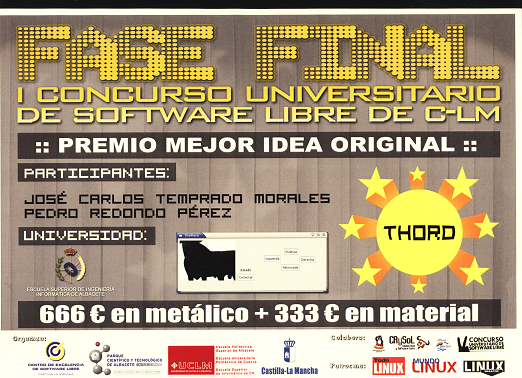
Best Original Idea Award

On April 17, the awards ceremony was held in Ciudad Real for the I CLM SL Contest, in which the ThoRo project was awarded Best Original Idea,

Diploma

Thank the organization for the award and the work done and congratulate the rest of the winners for their projects:

 Related articles:

Read more...

[Video] Bullfighting the ThoRo

Here we publish the video of the version presented in the I CLM SL Contest, so you will see the main developer of the hardware part, who has not been able to attend due to an operation (we hope you get better).

I am writing to you on-site, after having made the presentation and enjoying the workshops (Joomla, Security, Xen, PyGames) that the organization has prepared for us.

Read more...

SDK Released

Here is a screenshot of the initial interface that controls the ThoRo:


   Simply comment that the current interface is not the most important thing, but rather the SDKs, which provide support so that anyone with minimal programming knowledge can carry out any type of automation.

//We declare our game 

    ThoRo robot = new ThoRo() ;

//We send you the desired orders 

    robot.Go(); 

    robot.Back(); 

    robot.Right();

    robot.Left(); 

  You see that with simple instructions like those after having added the attached library, you can have at your command a machine to “dominate the world”, heh, heh,…

Read more...

First images of ThoRo

We leave you the first images of the initial Beta and how our Thorete reacts, in the next few days the first version of the SDK will be released for easy development of it

We hope you like it. Who wants one?? ;)

Read more...

Development environment

    Taking advantage of the possibilities of virtualization, we have created a virtual machine for VMWARE Server with all the needs to work on the project, from the MonoDevelop environment to a mips compiler.

    It is a Debian SID, the root password is “mono”, so you can use it for whatever you want, even as an OS. alternative.

 You can download it here.

Read more...

ThoRo scheme

 We present the scheme (in very broad strokes) that we are following in the development of the project

 And the communication protocol chosen will be the same for the <–> core interface as for the <–> arduino core. In this way we simplify possible misunderstandings, this being the following:

 * X Y # 

  • X is the device number to send the devices to.
  • Y data sent to the device.

 Every command will be followed in response mode by the receiver by a new command that will ensure its reception, in this case “ACK”

Read more...

Compile for MIPS processors (Foneras, WRT54GL, …)

    We are used to compiling our software against x86 systems, but… what happens when we want to run our software on other architectures? Basically, with a mere change of compiler if we have followed the POSIX, directives and little else we will be able to migrate our applications to the system we want.

  For example, devices like the fonera, the Linksys WRT54GL, the ASUS WL500G, …… have this type of processor and if we want to compile against them we only have to follow the following simple steps:

Read more...

First elicitation phase completed

   After a month of long work among a group of people carefully chosen to be able to reach the maximum possible number of people, we conclude the first of many subsequent ones that we make use of our selected ones.

Summary of conclusions:

  • Different modes of work:

  • Totally independent of the human being.

  • Controlled by the user (remote control).

  • “Learn …………. with Thoro” mode.

  • Open for new possibilities.

  • You must respect Asimov’s three laws of robotics

Read more...

The ThoRo project is born

   We started this new Blog to publish all the developments of the ThoRo Project, so that you are informed and participate in it, either developing, playing or simply giving ideas.

What is ThoRo?

   Thoro will be your pet tomorrow, with whom you can play, spend time, even bring you your favorite “soda.”

   It is based on a MIPS processor, and thanks to its fully modular design, new functionalities can be adapted to it.

Read more...

Create your own Telnet client in C#

Due to the needs of a new project, I have been involved in the need to establish a telnet connection, so since we start investigating we do it from a Pocket PC, although the code I present is independent of the device, even Mono.

After reviewing several dotnettelnet type libraries, I opted for Minimalistic Telnet, basically because it was more adapted to my needs and it is much clearer what we intend to do at the learning level.

Read more...