Android shell tricks

When you work as an Android developer, you should try to get as many shortcuts as possible in order to improve your productivity. Here I leave you some simple tricks that every “code-picker” should have as a rule.

To connect a device, the cable is a problem in the long run, I personally recommend always doing it from the wireless network, either activating it by hand or more simply with applications like adbWireless.

Read more...

Yocaina released for Android

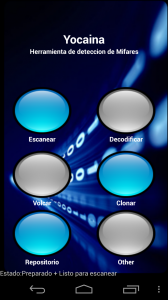
Yocaina is a Mifare card reader for training in the development of applications and NFC cards, using XML code it is possible to define several types of cards, thus ensuring the differences between each of them.

You can download it from the Play Store from the link Yocaina or using the QR code

Yocaina yocaina_qr

The application has been released under the LGPL license, and is prepared for the implementation of more types of cards, such as ISO 15693. You can contribute your code from the github repository:

Read more...

Reading brain waves (EEG)

Next Saturday, August 18, I will be at MUNCYT in La Coruña, with a talk on how to take brain wave readings with low-cost Electroencephalograms (EEG).  I will present the Theeg project and then Jose Angel Mateo will give a presentation on the DotNetClub.

Agenda

10:00-10:15 Presentation of the event and speakers. 10:15-11:00 ‘Theeg: Reading other people’s minds’ Theoretical session. 11:00-11:45 ‘Theeg: Reading other people’s minds’ Practical session. 11:45-12:00 Coffee break

12:00-12:45 ‘IEEE-UNED Microsoft DotNet Club’. 12:45-13:00 Farewell and closing.

Read more...

Global Alert, how to make a cross-platform application

I have been developing applications for mobile devices and AJAX developments for several years, and I thought the idea of ​​merging both was great. After studying many frameworks, I came to the conclusion that the one that best suited my needs was Phonegap, which with the purchase by Adobe after a while I realized that it was not exactly a mistake.

PhoneGap is an HTML5 application platform that allows you to author native applications with web technologies and gain access to APIs and app stores. Leverage web technologies to developers who already know best… HTML and JavaScript

Read more...

Auditfi code released

Auditfi has exceeded 1000 downloads, and as a thank you there is another little gift, and this is the total release of the code so that everyone can study it, and above all improve it. There are many more networks that can be included using patterns, dictionary or even brute force.

Project URL

https://github.com/Thempra/Auditfi


It has been located in the GitHub repositories, to manage it you can do it through Eclipse with the EGit plugin. As you can see, it is a very simple and easy-to-understand application. I hope you are encouraged to improve the project.

Read more...

Auditfi 1.0, auditing your Wi-Fi network from Android

A few weeks ago, my colleague Craswer and I bet how easy it would be to implement the security flaw in the Neikokz generators, on the Jazztel and Telefonica or Movistar routers, and in less than an hour, we obtained the result that we present to you. Now, by popular request we have decided to upload it to the Market.

Although there are several programs to audit the security of your router, here we leave you the Auditfi (Wifi Audit**) which is not only prettier, “the best”, but we accept your feedback to improve it based on your needs.

Read more...

Android Privilege Escalation Vulnerability

An escalation of privileges is when a user with limited permissions is able, through some security flaw, to elevate their role until they have more capabilities in the execution of their code, in this case this case reaches the root superuser.

Of the two possible codes, the second accompanies some simple instructions on how to “do evil” to an Android device, from this moment the device is compromised. Imagine this, for example, in an application of dubious origin that you install from the Market, it could obtain and send all your information. Or looking on the bright side, a more open gap to be able to root all versions of Android

Read more...

Android 2.2 (Froyo) for EEEpc and others...

I was somewhat curious this morning about the Android code for x86 platforms, and without a doubt I have had no better option than to compile it myself to see exactly what type of interface and applications I was getting based on what exists in the official repository.

Below I leave you the simple steps to carry out this action, the result is a somewhat slow operating system, but it can probably be solved by adjusting some parameters, I will inform you about the issue.

Read more...

Links to get started in Android programming

   One of the many techniques to learn a programming language or technology is to read, read, read and read, both code and books. Finding books is as simple as going to Amazon and placing an order.

   Regarding the code, you only need to go around and around until you find the necessary lines. Here are some links that you may find interesting to start making the first applications:

Read more...

[Developing with Android] Preparing the environment

INSTALLING IDE AND SDK

First we must have the necessary packages properly configured to run java

apt-get install sun-java6-bin ia32-libs

Download Eclipse from for example here.

http://eclipsemirror.yoxos.com/eclipse.org/technology/epp/downloads/release/ganymede/SR2/eclipse-jee-ganymede-SR2-linux-gtk.tar.gz

Unzip and run eclipse. In the “Help / Software Updates…” menu we select the “Available Software” tab and add as a site:

http://dl-ssl.google.com/android/eclipse/

We download and unzip the SDKs for development

http://dl.google.com/android/android-sdk-linux_x86-1.5_r2.zip

From eclipse we configure the SDK in “Windows \ Preferences” in the Android section we write the path where the previous downloaded file has been unzipped. Next we will add the necessary targets to run our compiled application.

Read more...

TTF Fonts in J2ME with a Canvas

In my latest experiments with J2ME I have found that the font classes ( javax.microedition.lcdui.Font ) are quite short to obtain a fairly nice design.

It is based on three types (FACE_MONOSPACE, FACE_PROPORTIONAL, FACE_SYSTEM), three styles (STYLE_BOLD, STYLE_ITALIC, STYLE_PLAIN, STYLE_UNDERLINED) and three sizes (SIZE_LARGE, SIZE_MEDIUM,SIZE_SMALL) . This today is surpassed even by any Web editor.

We should not despair or think that  ….. “Java is shabby and ugly” ….. since this depends more on the capabilities of the developer/designer than on the language itself that we are dealing with. That’s why the guys at 59Pixels have released a 59Fonts library, capable of saving us a lot of headaches.

Read more...

Duel of the titans: Windows Mobile vs Android

After the surrender of Palm and the failure to reach the public of OpenMoko, Google attacks with its Android Operating System being a reality, today the HTC Dream goes on sale, with this OS. embedded, being able to develop with languages ​​such as Java, Mono,…..

UPDATE: (HTC seems to be rumored to announce the launch of the Diamond in South Africa in Q4 2008) HTC Dream

And although theoretically it is new hardware, for some time now we have been able to see videos on YouTube of how it works on other devices.

Read more...